

Malaucène House
The Provence-Alpes-Côte d’Azur region is a magical triangle of land in southeastern France composed of 6 departments: Alpes-de-Haute-Provence, Alpes-Maritime, Bouches-du-Rhône, Hautes-Alpes, Var, and the Vaucluse. French departments were created in 1790 to give each part of the country relatively equal significance in government affairs. They were designed to be more or less the same size, with each department’s capital no more than a day’s horseback ride from their furthest corners.
Each of the departments in this region has its own special charm, but the Vaucluse seduces like few others with a heady mix of windswept natural beauty, rustic gastronomy, and celebrated vineyards. If you’re interested in discovering an authentic slice of French rural life, these 10 Provençal villages are ideal destinations.
How to Get to the Vaucluse
Trains run daily between Paris’s Gare de Lyon and the TGV Gare d’ Avignon, and between the Gare de Marseille and the TGV Gare d’Avignon. From the there, you can also take a 30 minute ride on the TER train to Carpentras. The best way to get around the Vaucluse is to rent a car from either Avignon or Carpentras;rental facilities are available at both train stations. The main autoroute through the Vaucluse is the A7, and the toll-free route is the N7.
10 Charming Villages in Provence’s Vaucluse Department
1. Beaumes de Venise

Beaumes-de-Venise View
With its aesthetically pleasing location nestled at the foot of the Dentelles de Montmirail, a small chain of mountains whose highest peak is Mont Ventoux, Beaumes de Venise is a typically charming, medieval, Provençal village. It is home to Muscat de Beaumes-de-Venise, a sweet, fortified dessert white wine considered one of the best muscats in the world. Grown on a thousand-year-old terroir called terre blonde, it comes from the grape variety Muscat à petits grains, which only the winegrowers of Beaumes-de-Venise cultivate in the Rhône Valley.
The village has many attractive features, such as the prehistoric Ambrosi and Rocalinaud baumes (caves), from which the place takes its name. Not to mention La Chapelle Notre-Dame d’Aubune, a 12th-century jewel of Romanesque and Baroque art. Its magnificent altar depicts the plagues in 1629 and 1720 that ravaged the village. The chapel was restored in 2007 and, more recently, a medieval botanical garden and olive tree grove were planted on the same site.
Accessible on foot, a hike on the Plateau des Courens offers a splendid view of the countryside and the Early Christian cemetery of Courens, which sits next to the Saint-Hilaire chapel: a vast cemetery built on the site of a Roman temple dating from the first centuries of Christianity. Some fifty sepulchers have been unearthed here during archaeological excavations.
There is also the Moulin à Huile Balméenne, active since 1856, produces over 350 tons of olive oil and is open daily. For those interested in the area’s Côtes-du-Rhône viticulture, the Rhônea winery offers a host of wine tourism activities and events throughout the year, including walks through the vineyard, tastings, cocktail-making workshops, off-roading, pony treks, treasure hunts, and more.
Market Day: Tuesday
Restaurant Recommendations: La Table des Balmes and Côtés Vignes by Coco
Distance from Avignon: 37 minutes via the D942
Distance from Carpentras: 14 minutes via the D90
2. Bédoin

Ochre Fairy Hills in Bédoin
During the summer months, when life moves at a faster pace, a surprisingly tranquil atmosphere radiates from the base of Mont Ventoux, which is regularly summited by participants in the Tour de France, and other avid cyclists. Beneath its large, centuries-old plane trees, the main street in Bédoin is lined with cafés, restaurants, shops, and small businesses. Notably, it hosts one of the best Monday farmers’ markets in the region. Even in winter a calm settles over the village, which is sometimes covered in snow.
Riddled with caves and rock shelters, Bédoin has been occupied since the Paleolithic period. First Greek, then Roman occupations favored agriculture in the area, in particular the cultivation of vines. During the Middle Ages, Bédoin was a fortified village ruled by the Counts of Toulouse. In 1250, Lord Barral des Baux gave the inhabitants of Bédoin and their descendants the lands surrounding Mont Ventoux, plentiful with springs, woods, and pastures. His historic residence, Château des Barroux, is located in the nearby village of La Barroux, and is open to the public for visits. Bédoin was almost wiped off the map during the Reign of Terror (1793-1794), but the commune slowly came back to life, and by the 19th-century was prosperous once again. Close to Bédoin, in the hamlet of Les Baux, you can enjoy a walk through vineyards, cherry orchards, and pine forests to the mystical Demoiselles Coiffées, ochre quarries dotted with Cheminées des Fées (fairy chimneys), carved out of the landscape by thousands of years of wind and rain.
Market Day: Monday
Restaurant Recommendations: Lily et Paul and Restaurant à Table!
Distance from Avignon: 39 minutes via the D942 and D974
Distance from Carpentras: 20 minutes via the D974
3. Châteauneuf-du-Pape

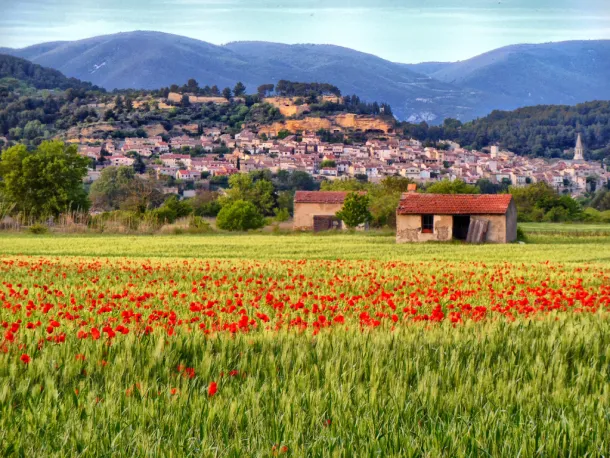
Poppies in the Vaucluse
The new château of the Avignon Pope, John XII, was built between 1316-1333 as his summer residence in the town now known as Châteauneuf-du-Pape, and it was he who planted the first vineyards surrounding this pretty, limestone medieval village, located on the left bank of the Rhône River. The château was occupied by eight different popes until 1378, when the papacy returned to Rome. Burned during the Wars of Religion (1562-1598), then further damaged in 1944 during WWII, only a part of the wall of the château remains, comprised of a high tower and a low room. From these ruins, a 360° view extends over the Rhône valley, the Luberon, and Avignon, with its Palais des Papes rising majestically in the background. You’ll pass beautiful fountains, the old village bread oven, and the olive oil mill while walking from the ruin down the small winding streets to the village below.
Designated in 1936 as the first Appellation d’Origine Contrôlée (a regulatory commission established to ensure the quality of grape varietals from their respective terroirs), Châteauneuf-du-Pape’s vineyards are 3,231 hectares in size, an area about 8.5 miles long and 5 miles wide. Its boundaries are the city of Orange in the north, the town of Sorgues to the south, and the Rhône River to the A7 in the east. An average of 13,750,000 bottles of Châteauneuf-du-Pape are produced every year. The clay-lined vineyards, whose round stones absorb the heat reflecting onto 13 varieties of grapes, along with the area’s unique climate, helps the grapes achieve ripeness few other regions can match. In the village proper, The Brotte Wine Museum is worth a visit, as is Domaine du Beaurenard just outside the village, which offers wine tastings of their delicious biologique (organic) and biodynamic (treated holistically as entire ecosystems) vintages.
Market Day: Friday
Restaurant Recommendations: Le Verger du Pape and La Part des Anges
Distance from Avignon: 27 minutes via D907
Distance from Carpentras: 30 minutes via D87
4. Goult

Village of Goult
Hidden in the heart of the Petit Luberon on a hilltop not far from Gordes, the village of Goult is swathed in old world charm. Due to its discreet location tucked into the surrounding hills, it is one of the most beautifully preserved, least visited Provençal villages in the area. The plane tree shaded squares, ecru and ochre buildings throughout its historic town center create a magical atmosphere. At the top of the village, behind the 13th-century Château de Goult (which is closed to the public), you will discover the Moulin de Jérusalem, a museum inside a windmill, which offers a glimpse into the historical significance of flour milling in the region, as well as an exceptional view over the valley’s terraced orchards, vineyards, and lavender fields. A self-guided, hour-long walk along the terrace’s cobbled paths showcases dry stone walls, bories (shepherds’ huts), cisterns, and arches. Also worth seeing is the 12th-century Romanesque Saint-Sébastien church, and the village ramparts.
During the month of July, beekeepers, artisans, and bakers gather in the centre of Goult for the Fête du Miel (Honey Festival). You’ll discover the secrets of beekeepers, learn about beekeeping techniques, and enjoy tasting products made from honey, such as nougat, gingerbread, ice cream, and mead.
If you’ve a little more time to spend in the area, you might consider visiting the hamlet of Lumières, tucked below the village of Goult along the old Roman route linking Italy and Spain. There is a chapel dedicated to the Notre-Dame de Lumières, Our Lady of Lights. Since 1659, following the healing of an ailing stonemason working on the church, it became the site of important pilgrimages, particularly for the feasts of the Virgin on August 15 and Sept. 8.
Market Day: Thursday
Restaurant Recommendations: Café de la Poste and Le Goultois
Distance from Avignon: 46 minutes via the D900
Distance from Carpentras: 42 minutes via the D900
5. Lacoste

Chateau de Lacoste
During the Middle Ages, Provence was not concerned with over-tourism. It was concerned with religious wars, sieges, looting, pillaging, and slaughter. In 1545, an army headed by Jean Maynier, the Baron of Oppède, set off to rid the Petit Luberon of religious heretics. Maynier thought Lacoste, a Protestant village surrounded by Catholic communities, was a village full of them. He made a deal at the gates of the village, the Portail de la Garde, that he would spare the villagers if they would grant him entry, but neither he nor his men spared anyone.
Most notably, however, Lacoste is known as the refuge of the notorious Marquis de Sade. In 1771, he took shelter in his grandfather’s castle, the Château du Marquis de Sade, to escape scandals in Paris caused by his libertine lifestyle and controversial writings, both pornographic and philosophical. When he wasn’t locked up or on the run, he was usually in Lacoste.
In the late 1990s, the ruins of the de Sade Château, along with an attached quarry, were bought by the late fashion designer, Pierre Cardin. Each summer he organized a music and art festival in the castle’s courtyard and quarry, transforming them into an outdoor performance area and stage. Still going strong, Cardin’s festival draws thousands during the month of July.
You can leisurely stroll through winding cobblestoned streets lined with beautifully kept old buildings which comprise a charming labyrinth that lead to Lacoste’s renowned art school, the Savannah College of Art and Design Lacoste, founded in the 1970s by the American art professor and painter, Bernard Pfriem. The school, known as SCAD Lacoste, offers programs there for students studying photography, advertising, architecture, and film. SCAD operates year round on the upper levels of the village, and its Galerie Pfriem is open to the public. Artworks, including paintings, jewelry, and more made by former students, faculty, and alumni can be found for sale in the SHOPSCAD boutique.
Market Day: Tuesday
Restaurant Recommendations: Le Sade and Le Café de la France
Driving distance from Avignon: 49 minutes via the D900
Driving distance from Carpentras: 46 minutes via the D900
6. Malaucène

Village of Malaucène
Depending upon the season, this former Huguenot stronghold is a relatively quiet village, surrounded by a lovely avenue of centuries-old plane trees. It is a particularly lovely place to stroll, where you can explore its medieval gateways, which survived the demolition of the 13th-century ramparts; its belfry, constructed in the 15th-century, and its many private houses, built between the Renaissance and the 18th-century. For a long time Malaucène prospered from its agriculture, paper manufacturing industry, and silkworm breeding. Ideally located, the village is now experiencing a revival thanks to its strategic position, from which thousands of cyclists every year participate in the ascent of Mont Ventoux.
The second largest spring in the Vaucluse, Groseau (a 3 minute drive from the village center) is a little slice of paradise, and a wonderful place to visit. Traces of human occupation have been found here, dating back more than 5,500 years. Legend has it that the spring is named after the pagan god Groselos, meaning grace, because no one but a god could produce such crystal clear water. A Celtic-Ligurian stela dedicated to Groselos can be found in the town chapel. In the summertime, the spring, whose famed water is potable, is the perfect place for picnics and relaxing.
Malaucène was also home to the summer residence of Pope Clement V at the Notre-Dame du Groseau abbey, located downstream from the spring. There, you’ll find a geological curiosity called Le Portail Saint-Jean. Legend has it that this massive limestone “door” is an entrance to a cave fiercely guarded by a fantastical animal: a Golden Goat. The door is said to open only once a year, to reveal a brief glimpse of a fabulous treasure. To add to this magical atmosphere, the forest above the spring is home to magnificent birdlife, a perfect place for birders and nature-lovers to visit.
Market Day: Wednesday
Restaurant Recommendations: L’Atelier de la Ferme and Chez Laurette
Driving distance from Avignon: 46 minutes via the D942 and D938
Driving distance from Carpentras: 26 minutes via the D938
7. Ménerbes

Village of Ménerbes
Named after the goddess Minerva, Ménerbes is perched above seemingly endless fields of vineyards and cherry orchards, and this lovely village has attracted writers and artists for decades. The French photographer and painter Dora Maar, who was Pablo Picasso’s muse and mistress, lived in a house there, located on rue du Portail-Neuf, following their breakup. It is open to the public, as is the house of the American artist, Jane Eakin. The Russian-born artist Nicolas de Stael worked in his atelier overlooking the valley below, where he produced 254 paintings in only fifteen months. Ménerbes was finally put on the tourist map by Peter Mayle’s book, A Year in Provence, which he wrote at his home just outside the village. Now it has returned to what attracted Mayle in the first place–a beautiful, quiet, medieval village.
As with other Provençal villages today, you don’t get a sense of the slaughter that occurred during the Wars of Religion (1562-1598), but in the 16th-century its Huguenot population withstood a force of 12,000 Catholic troops for 14 months. At one end of the village is the Citadelle, a 16th century fortress, and at the other end are the Cháteau du Castellet and the town cemetery, which has beautiful views on three sides. The cemetery is normally locked, but you can ask for the key at the mairie (town hall). In the centre of the village are a handful of restaurants. In the Place de l’Horloge, where the village’s clocktower stands opposite the town hall, you’ll find the Maison de la Truffe et du Vin, where you can find out all about the truffles and wines of the region, as well as taking wine appreciation courses in the summer.
There is also the Abbey of Saint-Hilaire, a former Carmelite convent dating from the 13th-century. Guided tours are available in English, and there’s a 15-minute walking trail, marked with blue arrows, which allows you to appreciate all the convent buildings, anchored to the edge of the rocky spur. The courtyard reveals one of the oldest dovecotes in Provence. Walking to the other end of the village, you can visit the Saint-Blaise Chapel, built in 1734. Saint Blaise is famous as the patron saint of wool and hemp (chanvre) carders. After leaving Ménerbes, once you’ve explored every charming nook and cranny, there are a few more sites that might peak your interest: The Notre-Dame des Grâces chapel, originally built to give thanks for God saving the villagers from the plague, and the Musée du Tire-bouchon, aka the Corkscrew Museum, which features a thousand corkscrews dating from the 17th century.
Market Day: Thursday
Restaurant Recommendations: La Bastide de Marie and Bistro Le 5
Driving distance from Avignon: 45 minutes via the D900
Driving distance from Carpentras: 42 minutes via the D31
8. Pernes-les-Fontaines

Pernes-les-Fontaines
The historically rich city of Pernes-les-Fontaines was the capital of the Comtat Venaissin territory–part of the Papal States from 1274 to 1791, in what is now the Provence-Alpes-Côte d’Azur region–until 1320. It was known as “La Perle du Comtat” during the reign of the Avignon popes. Situated between Carpentras and Isle-sur-la-Sorgue along the Nesque River, it is an ideal place for visiting, since Pernes is endowed with a natural spring and 40 marvelous fountains. Among the most beautiful are the Gigot Fountain at the foot of the Ferrande Tower, and the Cormoran Fountain near the covered market. You can pick up a map at the tourist office and follow the circuit of fountains, as well as the more than 20 artists’ workshops in town. Labeled the Ville des Métiers d’Art, a hub for artists and artisans of various trades, there are numerous activities and creative workshops all year round.
The fortifications of Pernes remain architecturally remarkable.There are three different tower-gates through which you can enter what remains of this fortified village: the Porte Notre-Dame, across a bridge constructed over the Nesque River (The Chapelle Notre-Dame was built on the bridge in the early 1500s); the Porte Villeneuve (11th-century); and the Porte Saint-Gilles (14th century). Once inside the village you can visit the Tour d’Horlage, or Clock Tower, a 12th-century vestige from the Château of the Counts of Toulouse. From the panoramic terrace of the château you have views towards Mont Ventoux and the Dentelles de Montmirail. In the center of Pernes you can visit the Ferrande Tower, which exhibits beautifully preserved 13th-century frescoes. The town also has an excellent covered market, which built between 1622 and 1627, and transformed into barracks during the First World War. Today it hosts temporary exhibitions and occasional markets, such as the truffle market in January.
Pernes also has 14 private mansions, some of which are listed as Historic Monuments. The Hôtel de Cheylus once housed some of the village’s Jewish community, who were known as “the Pope’s Jews” because they were tolerated by the papacy. The hotel has a ritual bath, called a “Mikvé,” still in operation, it is situated in the basement of the hotel and is thought to have been built around 1504.
Market Day: Saturday (During the summer, evening markets on Wednesdays)
Restaurant Recommandations: Les Filles à Maman and Au Fils du Temps
Driving distance from Avignon: 38 minutes via the D 38
Driving distance from Carpentras 13 minutes via the D938
9. Séguret

Village of Séguret
This small, fairytale Provençal village is dominated by a ruined castle built in the 11th century by Raymond V, the Count of Toulouse. The name “Séguret” comes from the Provençal “Segur,” meaning “safe.” Hidden behind its ramparts, it inspired a sense of security in medieval times. Roman sculptures have been found in the fields surrounding the village, including a three-meter-high statue of a Roman god, with an eagle at his feet and his hand on a wheel, which was found in 1876, along with a god of the forests holding a flute. Both statues are now in Avignon, but the village still has a statue of another forest god in the Chapelle Sainte Thècle, located in the middle of the village.
Once you park your car just before the village entrance, it’s just a short walk to the 12th century archway where the village proper begins. The charming, narrow cobblestoned streets in this vehicle-free zone lead past ancient stone houses and lovely fountains. You’ll pass the remains of the 10th century fortifications through the Reynier Gate, also called the “Portail de la Bis,” and the Porte des Huguenots, or “New Gate.” Rue des Poternes leads up through the length of the old village all the way to the corresponding Portail Neuf at the south end of the village. Tucked into a little square is a covered lavoir, or wash house, built in 1846, and the 17th century Fontaine des Mascarons with its carved stone faces.
Upon reaching the fountain you’ll have reached the center of the village. Continuing up through the village to the top, you’ll discover the Romanesque church of Saint-Denis. If you’re adventurous, you can follow signs to the castle further up a steep, rocky path. Séguret has a number of art galleries, workshops, and wine stores hidden discretely within the stone architecture of the village. And you shouldn’t visit without experiencing a tasting of excellent wines, as Séguret has a number of vineyards designated with Côtes du Rhône Villages AOC status, including the Domaine de Mourchon. Everything in this small town is beautiful, well maintained, and attractively restored, perfect for an afternoon of leisurely exploration.
Market Day: Thursday
Restaurant Recommendations: La Bastide Bleue and Le Mesclun
Driving distance from Avignon: 45 minutes via D942
Driving distance from Carpentras: 30 minutes via the D7
10. Vénasque

Village of Vénasque
Vénasque is a medieval village in the Vaucluse, perched on a steep promontory. Once known as “Vindasca,” the village emerged as a significant stronghold of the Memini, a Celtic tribe whose capital was established in the nearby village of Carpentras. The Bishops of Carpentras settled in Venasque, a site that was easily defensible. Besieged during the Wars of Religion, Venasque was never conquered. The fortified stronghold was referred to as the Comté de Vénasque, lending its name to the wider region known as the Comtat Venaissin. In 1125, the Comté de Vénasque came under the ownership of the Counts of Toulouse. After the defeat of the Counts in 1219, the Comté was transferred to the papacy. Following the French Revolution, Vénasque was annexed by France and placed within the new department of the Vaucluse. With this transition, Vénasque faded into history.
However, during the 1960s, Vénasque underwent a period of restoration, as both the French and tourists rediscovered the rich historical beauty of the region. Many artists opened ateliers in Vénasque, including ceramists, potters, and painters. Remarkably, the village managed to preserve its medieval architecture and authentic charm. One of the most notable landmarks is the well-preserved Baptistère de Vénasque. Dating back to the 6th century, it is one of the oldest religious buildings in France, with ancient columns believed to have been salvaged from Roman temples. Wandering through the village’s steep lanes, you’ll pass a beautiful selection of old Provençal houses and mansions, constructed between the 14th and 17th centuries. From the Esplanade des Tours Sarrasines you’ll see stunning views of the Dentelles de Montmirail and Mont Ventoux. And at Place de la Planette, you’ll not only see magnificent mountain vistas, but also the Fontaine Planette, erected in 1891 to commemorate the centenary of the Comtat Venaissin’s integration into France. A wonderfully fanciful way of exploring Vénasque and the surrounding countryside is doing so by donkey. The local company Venasqu’ânes offers walks and hikes with their donkeys to carry your children or belongings.
Market Day: Friday
Restaurant Recommandations: Les Remparts and Le Petit Choses
Driving distance from Avignon: 38 minutes via D932
Driving distance from Carpentras: 16 minutes via the D4
First published in Frenchly, March 14, 2025 https://frenchly.us/10-towns-in-the-vaucluse-worth-visiting/